Tuesday, April 29, 2014

The Silence of the Lambs ★★★★

Image result for Silence of the Lambs title screen


    There are some images acquired from watching the medium of film that are sketched in our minds and memories forever--Hannibal Lector is one of those said images. Lector is a chilling portrait of a man who is completely insane, yet exquisitely intellectual. He can parley with the most brilliant of minds and devour a portion of skin from your face in a matter of seconds. Although Lector's presence may seem negligible in the 1991 thriller entitled "The Silence of the Lambs," he is undeniably the man of the hour.

    Clarice Starling, the other half of our yin and yang, is an FBI Academy trainee with an illustrious record and buoyant future. It is for this reason, along with the fact that she is an attractive young woman, that ultimately sees to her assignment of interviewing Dr. Lector. A menacing serial killer, nicknamed "Buffalo Bill," is on the loose and the FBI is under the impression that the former psychiatrist and killer can profile a suspect.

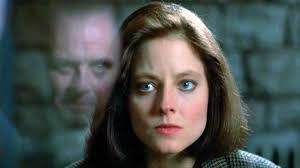
    The scene in which young Clarice first meets Hannibal Lector is arguably one of the most vehement exchanges of dialogue in the film, which sets up for this peculiar, yet beneficial relationship. Starling is brimming with self-confidence and professionalism, that is, until Dr. Lector profiles and dissects her lowly and rather harrowing upbringing. Nevertheless, Lector will provide Starling with a clue and a profile under the circumstance that he is transferred to another facility and that she participate in a quid pro quo session, where Lector exchanges information on the suspect for tidbits of Starling's past.

    Jodie Foster is the ideal actress to portray the poised, yet inexperienced agent Starling. Foster displays a sense of genuine emotion and instinctive mannerisms throughout the film, which highlights some of her finest talents; her exchanges of dialogue with Lector are impeccably crafted. Foster's character is a very intuitive individual, who also exhibits a perfectionist mentality. She has to find this killer while overcoming a dreadful past and the mind games of her new colleague.
    Subsequently, "Buffalo Bill" abducts a senator's daughter via tactics used by the very real and abominable Ted Bundy. This increases the urgency to find the killer, who could essentially murder his new victim at any moment. After Starling is forced to make a falsified offer to Lector, he finds an offer of his own directly through the senator. Lector is flown to Memphis, Tennessee, where he ultimately degrades the senator, but not before giving an invented name for the killer.

    This point of incarceration will become the opportunity Lector needs to escape confinement and become one among society once again. As for Starling, she will have to exercise all of her training and knowledge of this case to at last come face to face with the fugitive.

    Hannibal Lector is played by the one and only Anthony Hopkins. Hopkins performance here reiterates the fact that the casting of this film was nothing less than brilliant. I will never imagine another face to be Dr. Lector. Hopkins provides us with a very keen and sincere delivery of lines and emotions. (The reflection of Lector's dark and veiled face on the glass barrier of his confinement instills a sense of trepidation in us all.)

    This is a very difficult performance to endure; it is widely known that Hopkins only appears on-screen for a limited time; therefore, his delivery must be perfect. His role essentially makes this film. Lector acts as a confidante and mentor to Starling and, without his presence, all direction in her character would be lost. Starling needs Lector just as much as he requires her. These characters become a single entity and will continue their dance of intellect and subtle actions in subsequent films.

    "The Silence of the Lambs" is one of a handful of films to sweep all five of the major Academy Awards, including Best Picture, Best Actor, and Best Actress. Regardless of its popularity among mass audiences, this film is a genuine testament to the importance of characterization. Without a compelling set of characters, all interest becomes lost, and the significance of the plot will ultimately remain futile.

    This is a picture that will punch you in the mouth with its suspense and intrigue; it is a staple in a genre that seeks to blend horror with the captivating structure of a thriller. The last scene in this film sets up for a sequel, although when it was made there was no motivation for such undertakings. The final shot of Hannibal Lector merging into a faceless crowd, while stalking his prey, is the pinnacle of fear.


Friday, April 18, 2014

Noah ★★1/2


    Within the medium of film, there is an abundance of Biblically constructed movies, each containing or consisting of disparate portions of the Holy Bible. There is much to be said when these films come into existence, simply because they are held dear by some and are straightforwardly seen as epic storytellings by others.
         
    We must never forget, however, that because film is an art form, it is thereby realized that new releases (such as the 2014 film "Noah") may have been altered to some extent and will thus not yield a faithful version of the unfolding events at hand; they are essentially an interpretation. This film is a biblical exegesis of Noah and his perilous journey to save the innocent creatures of Earth from the cataclysmic and forthcoming flood.

    Noah, our protagonist, is a man of integrity and wisdom. He lives by his loyalty to the omniscient creator and leads a loving family of three boys and a single girl, Ila, who was found by Noah's traveling family after an attack on her people left her orphaned. This event leads to a deep-rooted and heartfelt love for the young girl in Noah. He cannot help but feel commiseration, for at a young age he had to witness his father's death at the hands of Tubal-Cain, who, subsequently, will be the only man standing in the way of Noah and his ultimate goal of breeding new life on Earth.  

    The prestigious depiction of Noah in this film is portrayed by the ever talented Russell Crowe; Crowe provides us with a frail and broken portrait of Noah, who is haunted by the burden of this great task. Although Crowe brings an acute sense of sophistication to this particular role, we are ultimately left with a one-dimensional character, whose one track mind is enveloped with only the ambition to complete the creator's task. It is not until the resolution of the film where Noah finally breaks free from this constrained and rather fugue state of mind to question his intentions--despite the fact that our interest has already been consigned to oblivion.
         
    After dreaming of morbid images bearing flood and death, Noah decides to seek out his grandfather, Methuselah, played by the ever-wonderful and talented Anthony Hopkins. As Methuselah, Hopkins induces Noah into a state that will produce vivid perceptions of seemingly otherworldly manifestations. It is now certain, for Noah has to build an ark to safeguard the guiltless inhabitants of Earth. Thus, Methuselah provides Noah with a seed that will sprout a forêt of monumental proportions. This will give Noah a plethora of lumber to finish the undertaking. All proceeds without impediment until Tubal-Cain and his callous following of individuals demand to be saved from the impending doom. However, Noah informs them of their destiny to remain on Earth, which lends an opportunity for the only antagonist of the film to come to fruition. (Besides, of course, the inner struggle of Noah and the probity of the creator's intent.)

    Other notable mentions include Emma Watson, who steps into the role of Ila, Noah's adoptive daughter. Watson is best known for her role in the "Harry Potter" series of films though I presume she intends to shed the previously innocent and virtuous image of Hermoine Granger. (As is the stumbling block for most actresses attached to a particular set of films.) Watson provides an emotionally charged performance, which is a refreshingly favorable contrast to the dreary temper of Noah.

    This is a film that does not live up to the esteem that it selflessly permeates. The storyline leads to a less than stellar climax, and the scene in which the mass population of computer-generated animals pour into the ark is quite monotonous. Love stories are fashioned and forgotten; characters are unwelcoming and unappealing. Nevertheless, there is an insufficient amount of positives, including the vivid images of the delightful Garden of Eden, the throbbing of the desirable apple, and the luring of the ever inveigle serpent.

    I have always deemed Noah to be an unassuming man; one who does not engage in the decipherment of the creator's wishes. He does not fully comprehend the purpose of the ark and the intentions of the ominous flood. In any event, no matter how one views this character, he is to be respected. This film would have been better off without the linchpin on vacuous entertainment, and, instead, a focus on the in-depth elucidation of Noah's magnetism.


Tuesday, April 15, 2014

Body of Lies ★★★


    Masterfully articulated spy films are a spectacle to behold and a pleasure to indulge upon. Films of this nature are innately suspenseful, and they indubitably lure the viewer in with their labyrinthine constructed plots and a charismatic set of characters. "Body of Lies" is a 2008 action spy film that consists of all of these aspects, yet it cannot thoroughly compel us to believe its ostentatious and rather inconceivable construction.

    Roger Ferris is a perspicacious and devoted agent to the Central Intelligence Agency. Apart from a blood sucking divorce that weighs on his conscience, Ferris finds himself on the ground in Iraq, where his current mission is to uncover the whereabouts of Al-Saleem, a fictitious jihadist terrorist. Ferris engages in human intelligence methods to infiltrate the inner workings of this faction and, with the help of a local associate, he has found a man prepared to speak in exchange for asylum. However, this plan goes awry when the informant is captured, thus forcing Ferris to assassinate him in fear that he would reveal his identity. Another off target bust, which ultimately leads to an RPG shootout, will force agent Ferris into an alliance with Hani Saleem, the stern and perceptive head of the Jordanian intelligence.

    Of course, although it seems as if Ferris journeys through the treacherous Middle East alone, support does reside in the form of Ed Hoffman, a superior agent who sits cloaked in the darkness of a CIA headquarters operating room with a vast array of technology at his disposal. Hoffman is the driving force of this "results-driven" company and, in stark contrast to Ferris, he spends most of his time completing daily routine endeavors, such as dropping off the kids at school and catching his daughter's soccer game. Hoffman will only grace Ferris with his presence if situations become defiant, otherwise sticking to manipulating procedures that undermine the integrity of Ferris. Add in Aisha, a Jordanian nurse and love interest for Ferris, and "Body of Lies" becomes the fully invested thriller that we ultimately hope for, despite the fact that we are left with a subpar resolution.

    The performances on display in this film consist of a blend of subtle interactions and swindling tactics. Leonardo DiCaprio plays Roger Ferris with a sense of style and dignity that we are ordinarily accustomed to seeing from this highly respected actor. DiCaprio portrays the preeminent qualities of this lead character on screen, who, at length, trusts his own instincts in lieu of the orders spewing from Langley, Virginia. Ferris is a man who leans on his intricate knowledge of terrorist behavior and the relationships formed through mutual understandings and trust.
   
    Russell Crowe is Ed Hoffman, a one-dimensional character who sloths through the film like a stick in the mud. There is nothing admirable (or even remotely captivating) about this individual to hold our interest. Nevertheless, Crowe extracts as much substance from this character that is humanly possible, even if he is just the epitome of a customary CIA employee, who flounders at sociability and mistimes photographs of family functions. In addition to these well-known faces are other notable performances, including Mark Strong, who steps into the role of Hani Saleem. Strong is noted for playing cold and distant villains, and he provides roughly the same range here although this time he is an ally. The relationships of these three men essentially spur the development of the plot and provide the backbone to this manhunt for terror.

    There is the notion that this film will be masterful if not simply for the lending hand of sensational director Ridley Scott. The celebrated director has produced several masterpieces in his time, and he is best known for his attachment to the genre of science fiction. However, this is quite the unfamiliar territory for Scott, who is best left to methodical and subtle camera motions that grip viewers tighter than a carnivore clasped on the body of its prey. "Body of Lies" is a film that relies on fast-paced action sequences to enthrall its audience, which is an unflattering sentiment toward Scott's directorial style. The eerie atmosphere produced by the gelid depths of space cannot be replaced with the desolate ambiance of the Middle East.

Tuesday, April 8, 2014

From Hell ★★★


    "From Hell" is a 2001 film that centers on the inexplicable murders that terrorized the fog enshrouded streets of late nineteenth-century London. This film is loosely based on the graphic novel of the same name written by Alan Moore. Ultimately, this fictionalized account, which follows the events and slayings of Jack the Ripper, will frighten and intrigue until the final curtain falls.

    Our film begins on the cobblestone streets of the Whitechapel district of London circa 1888. The camera guides us through numerous dreary filled images until it rests on the pale face of Mary Kelly--a female prostitute who lives and works in this impecunious district of England. Subsequently, Kelly and her circle of associates witness the kidnapping of Ann Crook, a friend and once prostitute herself. This event will coincide with the first of many killings targeted at these street level female workers, which puts the city on edge.

    These new and rather gruesome murders eventually gain the attention of Frederick Abberline, the local Whitechapel Police Inspector. Abberline is an eccentric man who spends his time in smoke-filled opium dens and downing glasses of Absinthe that have been laced with Laudanum. The effects of these intoxicants allow Abberline to succumb to "visions," which detail these grisly homicides and foreshadow events yet to occur. After enlisting the help of the royal family's physician, Sir William Gull, to aid in his quest to learn the identity of the murderer, Abberline discovers that it will take his brilliant investigative mind and a "trust no one" mentality to unveil the killer and restore peace to the streets of London.

    The performances in this film are a testament to the continuity and credibility that the actors portraying the characters have presented over the course of their careers. However, they lack the heart and soul that this film desperately needs which would ultimately make it a must seeJohnny Depp portrays Frederick Abberline, who was one of the most important investigators in the real life homicides caused by the notorious Jack the Ripper. Depp is a fine actor and displays his best qualities on-screen with an eloquent delivery of dialogue and mannerisms. Abberline may seem like a daft and utterly reckless human being, whose only ambition is to gain a release from everyday life. (This was an aspect of the film that the original writer of the fiction at hand, Alan Moore, discredits entirely.) Nevertheless, Depp is an essential component of the positives that brim from this story, and his performance is justifiably the sole reason to watch.

    The supporting performances lack the intrigue that surrounds the character of Abberline although they deserve an honorable mention. Heather Graham brings her illustrious career into the fold with her portrayal of the one-dimensional character of Mary Kelly. If you are familiar with the actual events of these slayings, then you will recognize her name as the last on a short list of victims and for being the most revolting murder of the crimes. Graham essentially guides the plot and dialogue in the direction it needs to go--and although she becomes the love interest of Abberline--it is very much short-lived. The role of Sir William Gull, which is also an element of the real Jack the Ripper case, is played by Ian Holm. Holm is a distinguished British actor who brings a certain sense of wisdom and maturity to the production, and it enriches the overall experience.

    This film essentially proceeds as a horror picture, which puts the viewer into a "who will die next" mode of reception. "From Hell" is not a film for the weak stomached, as there are many repulsive and grotesque images that are intended to give a realistic depiction of these murder scenes. At length, this is an interesting perspective into one of the darker moments in human history, even if it is a fictionalized account.
   
    Jack the Ripper's identity will virtually never be known, and the debate is destined to linger in the minds of anyone who remotely has an interest in this portion of history. The conclusion is dissatisfying to say the least, and this film would have been better served with a focus on the behind the scenes investigations that boggled some of the most brilliant minds of any nineteenth-century police force. Yet, there is a certain attraction to these dark and decadent filled streets of London. It is only natural that we, as human beings, become enticed by these spine-chilling tales of mystery and murder, even if unpleasant thoughts are inevitable.

Tuesday, March 18, 2014

The Wind Rises ★★★★


    "The Wind Rises" is a Japanese animated historical drama that centers on the personal life of Jiro Horikoshi and his career as an aircraft designer in World War II-era Japan. This film features wonderfully hand drawn animation, along with a beautifully executed film score. With legendary filmmaker Hayao Miyazaki lending his hand at writing and direction, this fictionalized tale of accomplished dreams and true love will leave you with a magical feeling of complete exuberance.

    This film begins with one of numerous spellbinding dream sequences that are to grace our presence. Young Jiro has a dream that introduces him to his love for planes and aviation. Astounded by this new found ambition, Jiro borrows an English aviation magazine, in which he diligently studies with an English dictionary to help translate. This leads into a second dream sequence that introduces us to one of the film's most convivial characters, Caproni, an Italian aircraft designer who is seemingly at the top of his game.

    Jiro has entered into the dream realm of Caproni, which is filled with phenomenal aircraft designs, friendly faces, and a backdrop of an endless green pasture and dazzling sun that will have you begging for spring. It is here that Caproni influences this young "Japanese boy" to follow through on his ambition and to become an airplane designer much like himself. In addition, this realm becomes the meeting place for these two friends, who have been fatefully brought together to express their passion and ideology for airplane mechanics.

Young Jiro with the great Caproni
    Accordingly, our story jumps ahead five years as Jiro is traveling by train back to Tokyo while on a break from his engineering studies. After briefly meeting a young girl named Naoko, the train and surrounding areas are hit with the devastating Great Kanto earthquake of 1923.
This scene will become the catalyst for the rest of the film and ultimately displays Miyazaki's brilliance in hand drawn animation. Naoko's maid suffers a broken leg in this traumatic event and, with the help of Jiro, she arrives safely back to her family. Jiro leaves and goes back to school where he eventually graduates and begins his work at an airplane manufacturer. Jiro's legacy will be defined by his devotion to this love for creating beautiful airplanes and his love for the young girl whom he met on the fateful day of the earthquake.

    The casting of voicing talents in this film are spot on and include some actors that you would never associate with Japanese animated characters. Joseph Gordon-Levitt provides the voice for the young protagonist of Jiro Horikoshi. Levitt executes this role brilliantly and for the duration of the film, you would never expect his voice to be behind this lovable character. Stanley Tucci lends his voice to the character of Caproni, who is very instrumental in guiding Jiro to the accomplishment of his goals as an aircraft designer; subsequently, helping Jiro discover himself.

    Hayao Miyazaki is a master at hand drawn animation. He displays a certain sense of elegance with the depiction of his characters, both internally and externally. (The faces and movements of the surrounding characters in the earthquake scene are proof of this.) The dream sequences complement this film exceptionally well and provide a much-needed release for our main character. Personally, I feel the scenes between Jiro and Caproni make this film and help to showcase the magic that you would normally expect from a Miyazaki production.

    "The Wind Rises" is a delicate and heartfelt film that will aspire even the most mundane of existences. The film sits just over the two-hour mark and will test the patience of the average moviegoer; however, it is well worth it. If you have never experienced the sensation of a well produced Japanese animated film, then this film would not be a bad start to begin your journey. It is exceedingly refreshing to see a two-dimensional film make it into the theater, even if it is not well received by mass audiences. We have become too accustomed to computer-generated films that try to replace story and character with over-the-top visuals and stunts.

    This film breathes new life into the world of animation with its marvelously inspiring symbolism and undertones. It may not possess the unique and extravagant worlds presented in other Miyazaki films, such as "Spirited Away," yet it is a picture to cherish, and it only adds to the legacy of one of the greatest animated film directors to ever engage the medium of film, Japanese or otherwise.

    "Airplanes are beautiful, cursed dreams, waiting for the sky to swallow them up."


Wednesday, March 12, 2014

Insomnia ★★★

Image result for Insomnia 2002 film stills

     
    Sleep is a sine qua non. Every human being needs a tranquil night of sleep to live and to function properly. "Insomnia" is a 2002 thriller that centers on sleep deprivation and its effect on a veteran LAPD detective while he is working a young girl's homicide. This picture is a remake of the 1997 Norwegian film of the same name. With direction by Christopher Nolan and featuring an all-star cast, "Insomnia" will delight and entertain with its fast-paced action and dark undertones.

     "Insomnia" begins with two LAPD detectives making their way by airplane to the small fishing town of Nightmute, Alaska. They have been assigned to help the local police force with a 17-year-old girl's murder. However, this is only one of numerous concerns that plague our central character, Will Dormer; Dormer is a veteran detective who has made reckless decisions in the past to guarantee that criminals remain behind bars. (Is this a crime?) Well, the internal affairs division of Los Angeles seems to think so, and they are knee-deep in an investigation of Dormer. Tagging along for this case is Dormer's younger and less perspicacious partner, Hap Eckhart. The relationship between the two is strenuous, to say the least, considering Eckhart intends to cut a deal with internal affairs to throw Dormer under the bus.

    Combine this with the fact that Nightmute is suffering from the perpetual daylight of the "midnight sun" and Dormer is in for a long work week.

    The murder victim is Kay Connell, and, after a small breakthrough by finding the girl's backpack, Dormer instructs for it to be replaced and to announce that it is missing. Consequently, this will inveigle the killer back to the scene of the crime where the detectives will be waiting. This particular scene, along with the aide of some thick fog, will set the blueprint for the rest of the film. Dormer will find himself in an even more precarious position than when he first arrives and realizes that he may have something in common with the would be killer.

    Our performances in "Insomnia" are modest to say the least, with the exception of Al Pacino, who even at an older age still proves that he has the mojo to carry a less than stellar cast. Pacino excels in the role of Will Dormer and demonstrates his experience as an actor. His dreary line filled face makes him an essential casting for this character, who, evidently, has seen one too many murders and has been beaten into submission by a career filled with dread and anxiety. Pacino's delicate performance breathes life into this gloomy film, and he displays flashes of brilliance in a few particular scenes, including a scene in which he interrogates and scorns a young girlfriend of Kay Connell.

    The rest of the cast is headed up by Robin Williams in his role as Walter Finch, a local writer, and admirer of the deceased teenage girl. Williams shines in this performance, which, unfortunately, is limited to phone conversations and short-lived dialogue. Nevertheless, Williams exhibits a sense of dignity and blends well with the character of Dormer. Their scenes together highlight this film and simply gives us a reason to watch. Hilary Swank, an Academy Award winning actress, rounds out this cast with her role as Ellie Burr, one of the local police officers of Nightmute. Swank is acceptable in her performance as a young and inexperienced detective who acts as a sponge in order to absorb all of Dormer's experience and intellect. Swank also converses well with Pacino and shows that she is more than just something sweet to look at.

    Christopher Nolan is best known for his role in the direction of the "Batman" trilogy of films and the much-overdone film "Inception." Nonetheless, Nolan changed the landscape of how we view the superhero genre. (Every picture that features a masked crusader will ultimately be pitted against those films.) This is more of an unpretentious project for Nolan featuring tedious camerawork, which he utilizes in a flattering manner, especially in the "fog" scene that fuels the plot and a chase scene through a logging site.

    "Insomnia" is a subtle film that indulges in the concepts of guilt and culpability. It is a suitable remake of the Norwegian original that showcases the fine talents of an aging legend in Al Pacino. The luminescent town of Nightmute and the "midnight sun" prove to be an excellent component of the film. In addition, the plot does not care to try and deceive the viewer with the identity of the murderer with other insignificant characters. This is a rather ingenious technique that should be adopted by the numerous thrillers that will ultimately grace our lives in the coming years. This film thrills, entertains, and doesn't pretend to be what it is not.
       

Tuesday, March 11, 2014

Patriot Games ★★1/2


   "Patriot Games" is a 1992 film based on the novel of the same name written by Tom Clancy. It stars Harrison Ford as the title character of Jack Ryan, and it is the second movie in a series of novels and films to feature this protagonist. Ryan is an ex-CIA analyst turned U.S. Naval Academy professor who, after interfering with an attempted assassination, is thrown into a game of cat and mouse with the lives of himself and his family at stake. This is a technically sound film with moderate direction; however, it falls short simply because of its inept ability to blend a seemingly intricate plot with the action and suspense we expect from an entertaining film.

   This film begins with Jack Ryan and his family, consisting of his beautiful wife Catherine and his lovable daughter Sally, vacationing in London. After giving a guest speech at the British Royal Naval Academy, Ryan walks the short distance to meet his family at a local park. This is where Ryan witnesses an attempted assassination on the life of Lord Holmes, a British Secretary of State and member of the Royal Family. Of course, it is only an "attempted" assassination due to the heroic efforts of Jack. He disarms one culprit and, after being shot once himself in the shoulder, he proceeds to shoot two of the other assailants, killing one of them. This lone climatic event will spur the rest of the storyline in this film.

   The man that Jack Ryan disarms is Sean Miller, the older brother to the man Ryan kills. Although the plot consists of varying components underlying this attempt on Lord Holmes' life, (including Irish Republic Army strategy) the film becomes one-dimensional and focuses primarily on Sean Miller and his efforts to enact revenge on Ryan by killing him and his family. There is little action to fuel the flames and to keep the viewer interested. In fact, we are ultimately left with a film that has forgotten that it should rely on suspense and thrills instead of mundane dialogue and conversation.

   This picture has many familiar faces and consists of a very talented cast. As mentioned above, Harrison Ford stars as Jack Ryan and, although his performance is unblemished, this character lacks the enthusiasm and charisma that this film direly needs. Jack Ryan is a reserved and dignified individual who is suddenly pitted against a man hell-bent on his destruction. This does not bode well for Ryan and, throughout the film, we wait for him to display some sort of emotionally charged anger to no avail. (I assume that is why he was always an analyst and never much of a field operative, as he is not cut out for killing, even if there is the motivation for that action.)
       
   Anne Archer plays Catherine Ryan, a doctor and wife to Jack. Archer is a very talented actress with a resumé that speaks for itself. She provides an emotional outlet for Jack, among other things, but, unfortunately, her presence ultimately comes off as nothing more than a plot device. Without her, there would be no collateral for Sean Miller to act upon. The attempt on her life gives Jack Ryan a reason to once again get involved in CIA operations and to try and track down this man. Sean Bean delivers a mediocre performance as the principal bad guy, Sean Miller. This character lacks all the necessary components of what a "villain" should consist of. Miller's only ambition is to kill Ryan; consequently, making him one-dimensional and a rather boring character. There are two notable appearances by seasoned, veteran actors James Earl Jones and Samuel L. Jackson. They are limited in screen-time and dialogue; however, their performances help shake the calm waters.

   "Patriot Games" is a film that teeters on the lines of intrigue and boredom. I mean, Jack Ryan has all the essential qualities that we expect in a hero, but he lacks the emotional traits that lure us into caring for the individual. This is a thriller that seems to just run through the motions, and it doesn't evoke the best out of its story or the actors.

    It all leads to a rather unexciting conclusion where all of the characters are coincidentally in the same place at the same time, and it becomes just another example of a best-selling novel that is begrudgingly adapted to film. (There is no denying that Jack Ryan is best viewed in the black and white borders of a novel.) The big screen intimidates Jack Ryan, who ultimately comes off as nothing more than a poor man's James Bond.

Tuesday, February 25, 2014

The Hobbit: Desolation of Smaug ★★★★

Image result for The Hobbit; Desolation of Smaug title shot

    Peter Jackson's "The Hobbit: Desolation of Smaug" is the second film of the trilogy based on the novel by the legendary J.R.R. Tolkien. Jackson is a master at blending superb special effects and computer graphics with tangible actors and actresses to create a spellbinding world, that, otherwise, could never be adapted into the medium of film. If "An Unexpected Journey" is the heartwarming beginning chapter to this sublime tale of Bilbo Baggins and the dwarves of Erebor, then "Desolation of Smaug" takes its rightful position as the climatic chapter of wickedness and divination.

    "Desolation" begins with a meeting between Gandalf the Grey and Thorin Oakenshield at The Prancing Pony of Bree. Similar to the opening of "An Unexpected Journey," this film sets the tone with a little back story. (Now, it is worthy to note that this seemingly chance meeting takes place prior to the events of the previous film.) Gandalf continues his role as the articulate initiator of fateful and perilous journeys; consequently, influencing Thorin to reclaim his throne among the majestic halls of Erebor and reunite the dwarves under his rule.

    This brings us to the current events at hand: Bilbo, Gandalf and the company of dwarves have successfully navigated past the Misty Mountains and escaped the wrath of Azog and his coterie of malicious Orks. However, that is the least of their worries. For, they are being pursued by another vicious entity who takes the shape of a colossal and thunderous black bear. Gandalf forewarns this company of the grave danger this particular circumstance presents and leads them to a nearby isolated home occupied by Beorn. After receiving aid from this "skin-changer," the company proceeds on their journey to reclaim the Lonely Mountain from the fire-drake of the North, Smaug.

    Subsequently, our heroic adventurers trek their way through some truly astounding environments that will captivate and enthrall the eye of the beholder. (In fact, I would go as far as to say that Jackson here is making a solid statement for the use of the digital camera when filming, even if there are several moments where the interplay between light and shadow falter; a known issue aligned with the use of the technology.) From the treacherous inner dwellings of Mirkwood to the splendid halls of the solemn Elvenking, Thranduil. Additionally, this film introduces numerous characters along with the revival of some familiar faces. Legolas, son of Thranduil, receives adequate screen-time to reign his destruction upon the hideous multitude of Orks that linger in the shadows of Middle-Earth. In addition, the introduction of the warrior elf, Tauriel, adds a much-desired air of femininity to the cast.

    The performances in "Desolation" are honorable in their own respect. Although the majority of the film is fast-paced and tends to indulge in extravagant scenes of action, there are a few notable showcases of talent. Martin Freeman reprises his role as the tedious and lionhearted Bilbo Baggins. Freeman continues to impress with his delicate execution of dialogue, especially when conversing with the dragon Smaug in the blackness enshrouded caverns of Erebor. Ian McKellen once again inspires all with his timeless depiction of the lovable Gandalf the Grey. Wherever this film has rough edges, McKellen smooths it over with his ebullient display of character, even if he is restrained in his on-screen time. (I very much desired to see Gandalf in the last thirty minutes of running time to no avail.)

    The performance to keep an eye on, however, is that of Richard Armitage and his portrayal of the heir to the throne of Erebor, Thorin Oakenshield. Armitage breathes life into this film where it is direly warranted, with short and emphatic soliloquies. Thorin is the blood that simply nurtures the veins of this film.

    This picture has been criticized heavily for its lack of plot development, among a number of other discrepancies. Unfortunately, it is an inevitable repercussion of attempting to extend a short novel into three films. Although, Peter Jackson finds an adequate balance between action and dialogue. Jackson even integrates the beginnings of a "love story" to please the female viewing audience. The ultimate downfall of being a filmmaker is the impossible task of pleasing all.

    "The Hobbit: Desolation of Smaug" is the reason we go to the theater; this film is made for the big screen. It delights, astonishes, and dazzles. It is a magnificent equipoise of special effects and conventional methods of filmmaking. There are a few scenes that involve somewhat horrendous executions of computer generated dwarves, most notably during the "barrel escape" segment. Nevertheless, I am forced to turn my cheek due to the realization that this is where filmmaking is headed. The days involving traditional camera direction and acting are done. The longing for films such as "Days of Heaven" is all but futile; however, "Desolation of Smaug" helps to ease this pain.

Tuesday, February 11, 2014

X-Men Origins: Wolverine ★ 1/2

 Image result for X Men Origins: Wolverine title shot


    "X-Men Origins: Wolverine" is a superhero film that premiered in May of 2009, and it is the fourth major motion picture to follow the characters and events of the X-Men universe. This film focuses on the early life and struggles of one of the most popular Marvel characters, Wolverine. With an unconvincing plot and scathing special effects, this film takes its rightful place as one of the worst superhero films ever made.

    We begin "Origins: Wolverine" in mid-nineteenth century Canada, as our main character, then named James, is bedridden with some type of illness. After being tucked in for the night, James overhears a confrontation downstairs that ultimately leads to the death of his father. This infuriates young James, who subsequently releases bone type spears from his hands, the first sign of his mutation gene. He plows the daggers into this murderer and, as he slips into the realm of death, the man reveals his true identity as James' real father. This startling information sends James fleeing from the scene, into the dark of night, accompanied only by his half-brother, Victor Creed. We are then shown various World Wars and other historical battles in which James and his half-brother are participating soldiers.

    James and his brother never seemingly age or die simply because their mutated DNA does not allow them to. Their bodies age progressively slower than any human, and they are blessed with incredible healing powers that reject any damage. I guess these attributes, combined with their natural instincts, would only allow for a military career. (I suspect if they were painters or poets, then we would not be interested.)

    This film wraps up the background story of our favorite mutton chop sporting hero with his involvement in the government program Team X and his subsequent departure from the group. Six years later, we find that our protagonist has a new career as a lumberjack and that he goes by the name of Logan. He lives a quiet and peaceful life in the Canadian countryside, along with his girlfriend, Kayla Silverfox. However, one fateful day brings Major William Stryker, the founder of Team X, to Logan's work site. He tells Logan that someone is killing the former members of this team and wants him to rejoin his forces. Logan's declination will trigger a set of events that will ultimately change him forever and send him on a blood-fueled path of revenge.

     The performances in this film are one-dimensional and simply uninspiring. Yet, Hugh Jackman reprises his role as the title character and delivers an emotionally charged performance. Jackman certainly looks the part of this powerhouse superhero due to his superb training regiments; however, his aim to create a terrific film is overshadowed by a dubious plot and unflattering special effects.

    Additionally, there are many scenes in which you will question the integrity of the screenplay. For example, after a confrontation with fellow mutant Gambit, Wolverine stumbles upon Victor in a Louisiana alley. Gambit breaks up the fight and allows Victor to flee. Wolverine then instructs Gambit to take him to the island in which Victor and Stryker are held up so that he can get his revenge. Could he not have just picked up the scent and followed Victor himself? (This is considering the fact that it was only moments before, and it was proved earlier that Wolverine has superior scent tracking.) The answer is no, simply because we would then not have any use for the character of Gambit, whose presence inevitably adds nothing to the story.

    Here we have a film that intends to build on the legacy of Marvel, but it ultimately falls tremendously short. It is truly unfortunate, as Wolverine is a very interesting character with a lot of potential on-screen. Maybe if the picture were catered more to the story than to failed computer graphic enhanced scenes, then it could have logically stood a chance. The Louisiana back alley scene, mentioned beforehand, is a perfect example of horrendous production design. It is as if you are watching the film on set, which kills any credibility going forward. If the "Dark Knight" trilogy is the pinnacle of what a superhero film can bring to an audience, then "Origins: Wolverine" is the cesspool of heinous and unimaginative thought.

Wednesday, February 5, 2014

Miller's Crossing ★★★1/2


    The genre of film known as "gangster" has evolved thoroughly over the years. We have come to love these movies unequivocally for their dramatic composition, their morose tones and superb dialogue. "Miller's Crossing" is no exception. This American gangster film was released in 1990 and, although it is overshadowed by a fellow gangster film of the same year, "Goodfellas," there is much to revel in. With direction by Joel and Ethan Cohen, this film will intrigue and entertain until the bitter end.

    "Miller's Crossing" opens in a style quite reminiscent with that of "The Godfather," albeit under different circumstances. We indulge in a conversation of ethics between two Prohibition-era mob bosses; Leo O'Bannon is an established Irish mob boss who currently runs the city, from political campaigns to police crackdowns. Johnny Caspar is a rival Italian boss who is on the up and up. The ill-tempered Caspar spouts his desire to kill a local bookie by the name of Bernie Bernbaum. However, O'Bannon quickly disengages the situation and tells Caspar that he will not revoke his protection of Bernie. This act of defiance by O'Bannon infuriates Caspar and persuades him to go to war with the Irish boss.
 
    The opening scene brilliantly sets the blueprint for the rest of the film; however, there are many integral components that surround this conflict and, therefore, they should be expressed. The protagonist of the film, Tom Reagan, is the longtime adviser of Leo, and his best friend. Tom warns Leo of this brash decision not to give up Bernie. In the code of "ethics," it is the right thing to do. Though, Leo is blinded by the love he shares for Bernie's sister, Verna. This beautiful dame cares for her brother and "steps out" with Leo in exchange for protection of Bernie. Tom knows Verna all too well, and their relationship ultimately turns the tables in favor of Caspar. In the end, it is the genius and manipulation of Tom Reagan that balances these relationships and the dynamic forces they present.

    There are numerous performances in this film that deserve praise and recognition:

    In one of his most prominent roles to date, Gabriel Byrne excels as Tom Reagan. Tom is a genuine and loyal adviser to Leo, and Byrne's Irish background makes him a perfect cast for this role. Byrne reaches into the pit of darkness and delivers a performance here that would inspire any young actor. This is a very delicate character to portray. There is a fine line between reasonable madness and insanity, and Tom Reagan is forced to walk this line. Byrne is unmatched in the control of his emotionally charged dialogue. Albert Finney portrays Leo O'Bannon with exquisite expertise. O'Bannon is an extremely likable mob boss who, when the time calls for it, can display the personality of a pit bull. Finney is excellent with these character traits despite the fact that he is limited in screen-time.

    Jon Polito is the moody Italian mob boss Johnny Caspar. Caspar is quick to change his mood from angry to angrier, and he imposes his will on any weakened prey. Polito is a perfect cast for this simple role of an aggravated, walking cardiac arrest. John Turturro and Marcia Gay Harden round out this wonderful cast. Turturro steps into the role of the strange and conniving Bernie Bernbaum. Bernie's motto is, "you can't have too many friends." He selfishly utilizes them in any manner that seems prosperous. Harden shows little range in the role of Verna and her personality is extremely similar to that of Bernie. She uses and uses until her needs are fulfilled. In this case, her sexual desires and the protection of a sibling.

    "Miller's Crossing" is a tremendous display of subtle direction and superior performances. If you covet a gangster film for viewing, then this movie will not disappoint. Its dark tones and even darker cinematography make it the perfect film for a late night showing. It will enthrall you with a world of greed and deception. There are many aspects of a film that, as a viewer, we need to fulfill our psychological needs. Sometimes, these needs can be found on the darker end of an endless spectrum of light. A film that can deliver on those promises and not leave you in a unwelcoming state of existence is a fine film to behold.
         

Monday, January 27, 2014

Meet Joe Black ★★1/2

 Image result for Meet Joe Black film stills


    Death is an essential, natural aspect of life. It lingers in the darkest of shadows, thriving on the weakness of humanity, and it graces us with its presence when we least expect it. "Meet Joe Black" is a 1998 film that relinquishes death as an ideal, and it gives this sentient entity a persona. This film is loosely based on the 1934 movie entitled "Death Takes a Holiday." With direction by Martin Brest, this American romantic fantasy will tease and tantalize, but ultimately it is overshadowed by what could have been.

    This film opens with our main character, William Parrish, sound asleep in his seemingly multi-million dollar estate. He begins to hear voices, albeit similar to his own, but doesn't make much of them. This, of course, is due to the fact that Bill is on the eve of a very important merger, which involves his company and another media mogul. (This is not to mention that he is just days away from becoming a senior citizen.) During these trying times, Bill manages to organize his time efficiently and even has a life changing conversation with his youngest daughter, Susan. She is currently involved with one of her father's board members, a young and brash gentleman named Drew, although her father can see that she is not "head over heels" in love. He encourages her to find true love as he sees it and to "stay open." For, "Lightening could strike."

    With this new found advice, Susan enjoys coffee at a local diner and meets a young man whose name is unknown to us. She enjoys a genuine conversation, and after multiple compliments, she becomes flattered at the thought of seeing this man once more. Little known to her (or him for that matter), Death is waiting just around the corner--literally. Death proceeds to take this man's life (in a ridiculous computer-generated hit and run) and embodies him. For, Death has an important mission here in the world of flesh, although it is mostly personal. He is here to obtain the life of William Parrish; however, after centuries of tiresome loneliness, he decides to take a personal tour of our world; he has chosen Bill to give him that tour. In exchange, Death will grant him more time, or, essentially, an extension of his life. This strange situation will breathe confusion into Bill's immediate family, and, most importantly, into the relationship between the unnamed man and Susan.

    "Meet Joe Black" exhibits a plethora of familiar and successful actors and actresses. Anthony Hopkins steps into the role of William Parrish. Hopkins is truly believable as this millionaire who is incredibly passionate about his family and career. He displays grace and dignity throughout the process, which is why we have grown to love him as a professional actor. Susan is played by the incredibly beautiful Claire Forlani. Forlani genuinely embodies the character of a young female doctor who is painstakingly naive when it comes to the concept of love. (I have never seen a pair of eyes more piercing than those that belong to Mrs. Forlani.)

    The complex role of Death is played by the one and only Brad Pitt. This is a very delicate role that involves how we believe Death would feel on an emotional front, how he would maneuver and speak. Pitt delivers these characteristics in an awkward and uneasy manner. Overall, this role is incredibly difficult to critique; besides a few notable and rather atrocious scenes involving Brad Pitt conversing in a Jamaican style accent with an elderly lady, Pitt strategically executes the role of Death in the best-perceived fashion.

    "Meet Joe Black" has all the components that a masterpiece should have. The problem is in regard to the execution of the plot and story. For example, there are two relationships at work in this film. First, you have the relationship between Death and Mr. William Parrish, then you have a romantic excursion between Death and Susan. These two partnerships take away from the morale of the film, and we are ultimately left with a feeling of emptiness. We scurry from plot to plot in an unflattering manner with little closure.

    Obviously, the sole inclusion of Parrish is to give Death a reason to enter into this world and to fall in love with Susan. The problem is, we begin to care for the character of Bill Parrish more than this contemporary and bland romanticism. This film has been criticized for its lengthy running time of three hours. Although it is true that we could live without the "love-making" scene involving Death and Susan, it does provide adequate time for the plot to develop naturally. Unfortunately, we over indulge in this meaningless romantic relationship and forget why Death graced us with his presence in the first place.

Wednesday, January 15, 2014

The Professionals ★★★ 1/2


    The old west is full of exciting tales involving gunfights, whiskey, and beautiful women in distress. "The Professionals" is a 1966 western film that includes all of these aspects and much more in a delighting fashion. This film is based on the 1964 novel entitled A Mule for the Marquesa, which was written by Frank O'Rourke. Nominated for three Academy Awards and featuring an all-star cast, "The Professionals" is a film that will linger with you for years to come.

    This western begins with a short montage of the four "specialists" that will be the centerpiece of the plot. There is a weapons expert, a horse wrangler, a scouter and expert tracker, and, lastly, a master of explosives. The hirer, J.W. Grant, is a rich Texas rancher who has nowhere else to turn except to these four men. His wife has been taken captive by a Mexican outlaw named Jesus Raza. The mission is to travel into the unforgiving and wretched Mexican desert to obtain the location of Raza's hideout and bring Mrs. Grant back home safely. This task will prove most dangerous, and, ultimately, everything is not what it seems to be between Mr. Grant and his blushing bride.

    "The Professionals" features one of the most entertaining ensemble casts I've ever seen in a western film. Henry "Rico" Farden, the weapons expert, is played by the most talented Lee Marvin. Marvin is genuine in this role of an ex-soldier who now makes a living by instructing militias in weapons training. (Earning a measly forty dollars per week.) When given the opportunity to earn a "big score" from Mr. Grant, Farden becomes the leader of this group of professionals and will stay true to his word. The secondary leader to this group of men, recommended to Mr. Grant by Farden, is the explosives expert Bill Dolworth. Now, Dolworth is played by the ever youthful Burt Lancaster. He is a notorious ladies man who served with "Rico" a few years back. Additionally, he is fearless in his line of work and is very tempted by money and the lure of beautiful women. In recent years, Lancaster has personally become one of my most cherished actors, and it is easy to see why. Lancaster is a natural performer with a voice that any radio personality would kill for. He works well with his environment here and is truly a pleasure to watch.

    Other notable performances include Jack Palance as Jesus Raza and the most luscious Claudia Cardinale as Mrs. Grant. Palance is a seasoned, veteran actor who brings a sense of dignity to the role of a Mexican bandit. (It is difficult to even recognize Palance under a coat of dark toned make-up and with him fluently speaking Spanish.) Claudia Cardinale is an Italian actress who is as talented as she is beautiful; Cardinale brings a certain spark and an air of humility to this male-dominated cast of characters.

    If you have not previously had an interest in the western genre of films, then this film will give you a reason to engage it. "The Professionals" will excite you from scene to scene and will leave you wanting more. Richard Brooks lends his hand to the direction and to the writing of the adapted screenplay, both of which earned him Academy Award nominations. Splendid scenery and your typical western musical scores accentuate this film in a respectable manner; however, this picture is made by the performances. Lancaster and Marvin are the pulse and livelihood of this movie. A masterpiece will be unmatched in direction, cinematography, and script. Unfortunately for this film, the performances outshine these essential components. "Amigo, we've been had."


Wednesday, January 8, 2014

High Crimes ★★

Image result for High Crimes film stills

    "High Crimes" is a 2002 thriller directed by Carl Franklin, and it is a picture that is based off a novel of the same name written by Joseph Finder. It is the second feature film starring the duo of Morgan Freeman and Ashley Judd as the title characters. With a subpar plot and very little intrigue, "High Crimes" falls tremendously short of any real expectations we should have for a masterful American thriller.

    This film opens with a startling image of several deceased villagers and a mourning mother. We are told this scene takes place in El Salvador, sometime in the year of 1988. We can also assume that these villagers did not die of natural causes, as their deaths seem to be the result of a multiple homicide. (This event alone will glue together the pieces of this below average storyline.)

    Fast forward to the present time period and we meet one of our main characters, Claire Kubik, in her Marin County, California, residence. She has just checked her ovulation test to find that she is in "prime" condition to conceive a baby. Why not get started immediately? She alerts her carpenter husband, Tom Kubik, and they begin to fool around.

    Everything seems picture perfect in Claire Kubik's life. She is a well to do defense attorney, who just succeeded in getting one of her clients a new trial, even though it seemed rather futile. The depiction of her received praise, as she enters her firm's law offices, only adds to the opinion that lawyers care more about their "wins" or "losses," then they do about the actual individual they represent.

    As if this rudimentary plot description weren't banal enough: Although, that is essentially all that is of any prominence here (the plot), considering this film cannot muster much more from its fragile structure. (It becomes even more fruitless as the storyline proceeds in its contrived dullness.)

    This "white picket fence" dream of a life is suddenly thrown to the dogs when, during a Christmas shopping spree, the FBI arrest her husband (in an utterly ridiculous scene with regard to plausibility) and charge him with the deaths of the nine civilians murdered in El Salvador. Claire Kubik must defend her husband's honor, and with the help of an ex-military lawyer, Charlie Grimes, she will unearth a reality that is as unexpected as it is preposterous. (Which is very.)

     The performances in "High Crimes" scream of mediocrity. The beautiful and talented Ashley Judd stars as Claire Kubik. Judd plays this character to the best of her abilities, or as well as the script allows her to. In a few emotionally charged scenes, Judd does show her credibility as an actress. She once again plays the "victim," and Judd has a natural talent for playing these types of roles.

    The only bright spot in this film is the character of Charlie Grimes, played by the one and only Morgan Freeman. Grimes--as mentioned above--is an ex-military lawyer, who is enlisted by Claire to help prove her husband's innocence. He is a man who spends his time counting the days of his sobriety and cherishing life without conviction. Freeman brings his brilliant range as an actor to this less than deserving film. He breathes life into this role and produces an edge that this picture so desperately needs. It is a shame that his performance becomes overshadowed by the inept story and the lack of surrounding talent.

     Movies in the "thriller" genre of filmmaking are supposed to do just that: thrill and entertain the audience. "High Crimes" is a bitter example of what happens when a semi-interesting novel is begrudgingly transformed into a dull and unmotivated film. The direction has its moments, but, overall, it is not consistent enough to keep us involved. Case in point: There is a scene in which Claire answers her cell phone and that apparently calls for a sudden, fast paced and jerky close-up. It only proves that there are masters of filmmaking and others who do not understand the delicacy of such techniques.