Wednesday, May 13, 2015

The Prince of Egypt ★★★1/2

Image result for the prince of egypt dreamworks


    We are told at the beginning of Dreamworks' "The Prince of Egypt" that the film remains true to the essence, value, and integrity of the story at hand (that being the book of Exodus and Moses), and this is verifiable to a certain extent. In fact, we have a picture here that not only indulges into themes scarcely aligned with children's animated features, but one that has a tone and mood brimming with a hint of fear; a fear that can only be attributed to God's wrath. (Which can be quite a profound experience for any adolescent.)

    Although the focus of Exodus does tend to highlight that of Moses and his journey to enlightenment, it is the actions of God and his intentions that really strikes us most. I mean, everyone with a personal faith of some kind pines to feel this relationship with their believed creator of life, and Moses is a persona that brings this seemingly impossible connection to existence. The few scenes in which our main protagonist actually interacts with God are surely the most important, and undoubtedly the most difficult for the actor in the moment. (In this particular instance it is Val Kilmer who, much like Charlton Heston in Cecil B. DeMille's "The Ten Commandments," ironically voices both.)

    Several scenes become overdramatic at times (most notably when Moses commits a punishable act, and the brotherly separation that it causes thereafter), yet the film never forgets to inject a quiet moment of reflection or internal conflict, as Moses struggles to accept his real heritage and subsequent role in God's plan. This film is a delicate piece of work, if for no other reason than the fact that it is simply the first insight into the morals of God, which must be accepted by this single man, as he comes to realize how thoughtless the actions of the Egyptians actually were.

Image result for the prince of egypt movie Moses

    This is somewhat of a breakthrough for children's entertainment, especially considering the depth of the subject matter and the lack of promotional tie-ins--the latter of which being influenced by the decision of Dreamworks co-founder Steven Spielberg. Its reliance on tawdry humor is at a minimum, and although symbolism is conveyed in rather simplistic manners, it is this sense of "compactness" that works so well. Character's allude to certain philosophical views with phrases such as: "Sacrifices must be made for the greater good" and "I cannot change what you see," all in an effort to condense a historic and life changing event into one epic showing; a notion that could hardly be expressed by last month's lovable Disney release entitled "A Bug's Life."

    The texture of the picture is truly a wonder to behold, as it essentially becomes dictated by the mood of the scene. Soft, muted color tones are utilized in moments of elation, and dark shadows encompass the atmosphere when things seem to become more serious. (This can certainly be ascertained during the night of God's wrath, in which he takes the life of every Egyptian firstborn, as the only visible color becomes a series of red streaks--or lamb's blood--which helps to protect the Jewish people amidst a background of pure darkness.)

    What makes this film even more compelling is its musical composition, which comes in the form of several symbolic songs and a masterful score composed by Hans Zimmer. It is obvious that Dreamworks intentionally pulled out all the stops in what becomes their first hand-drawn animated feature film. The question now becomes whether or not they can continue the magic. (An indefinable quality which only the likes of Disney and Don Bluth have been able to capture and share many decades over.) However, one thing is for certain: As long as Spielberg has a hand in the production, success becomes generally inescapable.

Thursday, April 30, 2015

Avengers: Age of Ultron ★★★

Image result for avengers age of ultron stills


    As "Avengers: Age of Ultron" descends into theaters with no regard for one's financial stability, it only alludes to the notion that Hollywood blockbusters are still very much in demand, especially if they contain characters of superhuman capabilities and costumes that utilize the synthetic fiber of Spandex, among other aspects. Although the film hits on several key notes that were regrettably forgotten in the first installment, "Age of Ultron" does little to make that progression towards something that is more sophisticated than what it actually is: An adequate action film, with a central concern of plot and character, whose CGI is as overbearing as the picture's reign on the weekend box- office.

    After Loki's plans for world domination were derailed in the first go-round, his all powerful scepter was taken by an organization that goes by the name of Hydra, a group who does little justice to the creature of Greek mythology and whose appearance would certainly conjure the distinction of unintimidating. In an opening scene that would surely make any action picture grimace with envy, we are taken through a snow filled terrain, as our ensemble cast of characters proceed to dismantle any resistance with relative ease. The scepter is retrieved for safe keeping and the heroes retire back to their glamorous base, which also seems to double as a penthouse.

    In a plot line similar to that of Mary Shelley's "Frankenstein," Tony Stark, our resident egoist maniac, indulges in a scientific study of the jewel that powers this weapon, ultimately finding an intelligence that can be utilized for personal gain. (Stark has created a line of robotic beings, which he believes can be infused with this intelligence, all in an effort to provide the world with a united defense program, so that The Avengers can take a permanent leave of absence.) This backfires, however, and the group is confronted by Ultron, a personification of the foreign intellect who found refuge in the battered frame of one of Stark's creations.

    This leads to a complication of relatable proportions, as Ultron essentially adopts a Manifest Destiny approach to contemplation, as he believes that the world must be allowed to kill and expand in order to evolve. (This can also be seen as a satire of today's foreign relations, as The Avengers take on the image of the United States, with their worldwide policing intentions, and Ultron comes to reflect a short list of countries who want to rid the Earth of this obstruction--i.e., Iran and North Korea.) Our heroes must stop this irrational enemy in order to keep the peace once more.

Image result for avengers age of ultron stills

    If there was one facet of "The Avengers" that I heavily scrutinized, it was the lack of humanness attributed to the cast of heroes. This is not only important for basic characterization purposes, but it appeases the notion that these characters aren't immortal (outside of Thor), and that they can become vulnerable and relatable to the average joe. In essence, it recalls the virtue of courage discussion conducted by Plato, in which it becomes evident that an individual that projects himself in a life-threatening circumstance is only being courageous and brave if they are not skilled in the matter at hand. (Superpowers certainly come in handy when one is bashing skulls, and if no weakness is conveyed, then the picture not only becomes predictable, but it would relish in tediousness.) Yet, the film brilliantly executes this much-needed quality in two particular sequences, which not only gives us an insight into the man or woman behind the costume, but it gives the film a sense of authenticity.

    Nevertheless, this newest installment, in what is surely a beloved franchise, continues to falter in several areas, namely the treatment of the villain and the atmosphere. Sure, Ultron is rather menacing in appearance and promotes that distinctive witticism that all comic book villains strive to achieve, yet his formidability is completely lagging, and he essentially becomes nothing more than an extension of his henchmen, which seem to be our heroes' main focus for both films. (Can we see an Avengers picture in which the characters actually fight the central antagonist for more than a handful of minutes?) I am assuming that this Thanos character, who has been brought to our attention several times during mid-credit scenes and over several different comic book universes, will rectify this imperfection.

    As far as the ambiance is concerned, there is no doubt that Marvel caters to younger audiences with its lack of gore and the nonexistence of a comfortless mood, yet these things are direly warranted. If they ever hope to compare to the likes of Nolan's "Dark Knight" trilogy, then these aspects must be included--not only to give the film a hint of poignancy--but to relinquish art in its most purest form; Marvel is ultimately robbing us of a key attribute of masterful filmmaking: an indulgence in human emotion, which basically stems from a dreary and unforeseeable tone.

    There is a scene in the latter portion of the film when our heroes boldly circle and defend a vital ingredient to Ultron's sinister scheme, that ultimately brings about a feeling of disappointment. As Captain America indulges in a "Matrix-esque" set of moves, the overbearance of the computer generated imagery rears its head and becomes quite laughable to a point. (This is in addition to a previous sequence littered with rescue attempts, where it is blatantly obvious that the film's events were created in front of a green screen.) When it comes to a picture of this stature, CGI becomes the ultimate paradox. Of course, it is needed in an effort to replicate the actions at hand, but if not used in moderation, it simply becomes forced and rather ludicrous. If anything, however, it is a disheartening feeling to know that the majority of a film was created by a computer.

    The financial success of "Avengers: Age of Ultron" (I wholeheartedly expect the film to break the record for fastest to one billion dollars revenue worldwide, recently set by  "Furious 7") can be attributed to numerous individuals, but one group in particular stands firm and this would be the marketing and public relations team. There is no question that branding plays a major role with triumph here, and it is no coincidence that the global empire of Disney plays the role of puppet master. For, they are the quintessential branding machine.

    Although there is nothing politically incorrect with this sentiment, there is a rather annoying ramification of this process. Millions of individuals will flock into this screening already loving the picture, and it certainly clouds their minds during the viewing and afterward. What ultimately takes place here is a democratization of talent. Does this picture deserve the recognition it has received or is this just a consequence of placing several beloved heroes together, accompanied by promotional ties and action figures? I guess only one question remains: Why has it taken so long for DC to catch on to this formula?

Monday, April 27, 2015

Paul Blart: Mall Cop 2 ★

Image result for paul blart mall cop 2 stills


    "Paul Blart: Mall Cop 2" is not only a dismal film that will bombard you with countless scenes of stupidity and send you reeling to the exits in a disheartened state of regret, but it is a comedy that adopts the personality of its main protagonist. Much like how the static persona of Blart is oblivious to his embarrassing and absurd tactics, which would never actually succeed in their aims, this picture is quite incognizant of the fact that it simply isn't funny.

    Although it is true that the designation of a comedy picture as amusing, hilarious, or any synonym of the like could be deemed a highly subjective process, there is still a nagging question to be asked here: Why would anyone find this material to be entertaining? I mean, who desires to watch a middle-aged man, in poor physical shape, tumble across the floor as if he was a small child engaging in a scene of adolescent imagination?

    The only logical basis for this unwarranted yearning would be the fact that our hero is quite overweight, and this apparently contributes to his comical allure. (Even the name "Blart" signifies lethargic behavior and obesity.) As far as who actually finds this subject matter to their liking is concerned, I'm sure it consists of very young children and individuals who would never understand the Joseph Conrad reference that our protagonist ultimately butchers.

    In a storyline eerily similar to that of the original, "Mall Cop 2" once again places our main character in an "against all odds" type scenario, and this lends the opportunity for a theme of human dignity and the struggle to rectify one's life and reputation. After several unfortunate events place a strain on Paul's life, he receives an invitation to a mall security convention in Las Vegas. (Although this setting has become renown for its visual impact, it lasts all but about two minutes; unless, of course, you find the inner dwellings of a hotel to be as grand as the Vegas strip.)

    A conflict consisting of high-tech art thieves is never fully developed and throw in the complications with Blart's teenage daughter, Maya, who is finding her way into womanhood, and you pretty much have the gist of a film that not only should never have been produced, but it makes the genre of comedy appear to be on its last legs. The dialogue, although eccentric, never fits the mold as funny, and the film's reliance on physical and situational humor is undoubtedly pathetic, although I assume that was its purpose. There is the classic hypoglycemic tumble, a plethora of scenes where Blart strains his face for comedic effect (to no avail), and several tactics that allude to the skills of "MacGyver," yet none of these instances evoke actual laughter; and, for the most part, this would summarize the historical efforts of Happy Madison productions.

    What this all basically comes down to is an issue of consumerism with regard to the movie theater chains. If they are going to show a picture of this magnitude, then it becomes perfectly reasonable to uplift the Prohibition-esque banning of alcohol. In fact, one should not be opposed to the idea of a free drink with the purchase of a ticket. I'm not saying that a shot of whiskey and a good brew will magically induce a feeling of amusement when it comes to films such as "Paul Blart: Mall Cop 2," but it couldn't hurt.

Sunday, April 19, 2015

Fast & Furious 7 ★★

Image result for Fast and furious 7 movie stills


    "Fast & Furious 7" is not only a substandard film, but it exemplifies the poor taste in entertainment that the general audiences of the United States have obviously become accustomed to. Are we really going to sit here--looking through an objective lens--and praise this picture? I for one will not succumb to this mystifying unfaithfulness with regard to the filmmaking industry, and any contemporary of mine who deems this "the best of the franchise," or as a superb film altogether, is clearly delirious and would not know a quality action picture if it walked up and smacked them directly in their untenanted noggins.

    If anything, the "Fast & Furious" franchise has become nothing more than a drawn out soap opera, complete with storylines infused with outrageous heists, crackdowns on crime and drug lords, tales of revenge--and what has become a faint whisper over the last several films--a focus on street racing and swift automobiles. (The glamorous cars are still present mind you, however, they act as more of a prop than a catalyzer; the emphasis has now been placed on stunts and action sequences that the resident actors would never be able to execute in actuality.)

    Additionally, character's deaths have been rectified, links have been tied to previous films (which have subsequently been shifted in sequence to essentially create a script), and the budget has expanded in a blatant effort to supply audiences with more foolishness and less imagination. The newest installment is rather loyal to this formula, although fresh faces do make an appearance and the final product recalls the phrase "over-the-top" more so than before.

    For those of you who have actually kept up with this helter skelter series of films, here is the summarized plot:

    After renegade mercenary Owen Shaw passes away in a coma, his older sibling, and trained assassin, Deckard Shaw (Jason Statham), appears to exact revenge. Shaw, who is coined as a "legitimate English badass," first encounters Hobbs (Dwayne Johnson), a current DSS agent and ally to our main protagonists. The ensuing battle, which features a poorly filmed fighting sequence, leaves Hobbs in the hospital until further notice, and Shaw escapes to continue his manhunt.


Image result for Fast & Furious 7 images
 
    From here, the film makes ties to the third installment and centers on this feud between Shaw and the team that killed his brother. Enter Mr. Nobody (Kurt Russell), a nonchalant government agent of sorts, who now proposes that Dominic Toretto (Vin Diesel) and his group of flunkies shift their attention to a device called the "God's eye," which utilizes digital technology all over the world, including mobile phone cameras, to track down specific targets. (This is not only unethical, but it would seem to be a poor satire of the government's ambition to exploit the population to achieve executive objectives.)

    In turn, Toretto will have full access to this instrument in order to find Shaw, even though the latter is in a constant search for the team himself. The acquiring of this gadget will lead to numerous scenes of disbelief, including a rescue sequence that features parachuting vehicles from an airplane--which is as entertaining as it is preposterous--and a scene in which a high-powered automobile leaps through three skyscrapers in an outburst of absurdity.

    What we essentially have here is an ensemble cast, which has its moments, yet they are ultimately drowned out by a less than stellar script and by enough explosions to make even Michael Bay seem rather reserved. There is the Letty Ortiz (Michelle Rodriguez) subplot, which not only adds little depth to the story, but serves as more of a distraction than anything. When the film attempts to inject moments of sentimentality, it not only disrupts the flow of action, but it places a strain on the actors, particularly Vin Diesel, who certainly lacks any sense of emotion.

    I understand that action stars are quite opposed to the subtle techniques of those in drama, yet even with a dialogue consisting of nothing but one-liners, Diesel seems to be in a realm of bewilderment. To put the performance into context, I have seen more conviction in a high school rendition of "Robin Hood."
         
    There is a moment in the picture in which our lovable cast of characters come face-to-face with the enemy and have the opportunity to conclude what has been a dreary production. Of course, however, this never happens, and we are left to endure a half hour resolution that evokes a feeling of torment. The late poet Edgar Allen Poe once put forth the notion that a short story should be capable of being read in one sitting; the same idea applies to film. "Fast & Furious 7" not only refuses to end a terrible outing, but it adds further injury to an already tender wound. If there is one aspect of the picture that could serve as an indicator of its incoherence, it would certainly be the numerous sequences in which the art of editing was seemingly forgotten. Editing does serve a purpose, and even films of this caliber should be able to accommodate.


Tuesday, April 14, 2015

Home ★

Image result for Home film 2015 stills


    There is something rather nostalgic about the picture "Home," a children's animated film that attempts to persuade us into thinking that it is ok to be different and that "nobody's perfect." These wistful feelings come into existence simply because it reminds us all of how inattentive Dreamworks has become with its children's productions as of late (outside of the "How to Train Your Dragon" franchise), and leaves one longing for the days of when "Shrek" first came to fruition, among other notable titles.

    In what is to surely become one of the most idiotic storylines of the year: The Boov, a small alien race who can change color according to their emotional state and who tend to run away when trouble arises, invade Earth in an aim to--what else?--escape the Gorg, another extraterrestrial race whose intent is to destroy the Boov. Humanity is consequently relocated to Australia (as a result of this inexplicable invasion in which our attackers disable our source of gravity) and the Boov swoop in and take refuge in our furnished city and suburban homes.  

    Enter Oh (Jim Parsons), a problematic and awkward member of this unsightly group of beings, who tends to scare off any intimate relationships that come his way. After becoming ostracized from the community, Oh fatefully runs into Tip (Rihanna), a young teenage girl who avoided the human "relocation," and whose only goal is to become reunited with her mother. The two set off on a quest to track down Tip's only remaining family and to rectify Oh's mishap, which has not only made him a fugitive, but has placed the Earth's well-being in immediate danger.

    Beyond the fact that the plot relies too heavily on its cheap physical humor (a favorite among young children), the conflict is overly forced, and to be quite honest, could not be more brainless. For, Oh is condemned among his own people for good reason. In a moment of intense excitement for the Boov's new dwellings, Oh mistakenly sends a party invitation to every being in the universe, including the Gorg, the before mentioned sworn enemy of the Boov. Now, if one ignores the fact that the Gorg are somehow on the Boov's e-mail list, as thoughtless as that may seem, it becomes obvious that Oh deserves harsh punishment. In fact, I believe treason, even if performed in error, becomes punishable by up to five years in prison here in the United States.

   
    "Home," in its most primitive design, attempts to define success by giving audiences a miscalculated story, an unattractive lead character, and a large dosage of music composed by Rihanna, herself, in a blatant exhibition of self-promotion. Nobody would have claimed E.T. to be a friendly looking character among first examination, however, he ultimately won us over with his warmth and subtle affections. Oh not only consists of none of these desirable qualities, but he certainly takes on the persona of Parsons, who thrives in an air of annoyance. If Dreamworks has any shot of reclaiming its dignity and becoming comparable to Disney once more, then productions of this magnitude must be avoided at all costs.

Tuesday, April 7, 2015

The Avengers ★★★

Image result for The Avengers film posters


    It seemed like only yesterday when superheroes were yet to be fashioned in the medium of film; and yet, here is a picture that not only features several of these personas, but it relishes in the mere fact that this "teaming up" of individuals is actually plausible. I could only imagine how Stan Lee felt when it was realized that these heroes were going to be lifted from the pages of his beloved comic books and onto the silver screen. This old-fashioned notion has now become a reality.

    But let's face it, "The Avengers" is simply that. It is undoubtedly the truest of the comic book films to the actual medium itself, as its rudimentary plot and simplistic characterizations lend the opportunity for fast-paced action and events. There are tawdry one-liners and little doubt as to what is going to take place, yet the artistic semblance of truth never wavers in its attempt to ensnare the audience.

    The plot, in its most primitive design, essentially focuses on a small power source, named the Tesseract, and its potential to do--what else--destroy the Earth. A bad guy from another dimension, Loki, (who basically takes the form of a middle-man as he has more prominent employers) transcends time and space to retrieve this object, as he is promised the remains of the planet after an alien invasion destroys its inhabitants. (This not only sounds questionable, but it would seem that Loki is getting the business end of the deal.)

    We are then introduced to our protagonists, whether begrudgingly or not, through one-dimensional executions of character; for example, we know that Nick Fury is a man of a strict disposition, if for no other reason than for his demeanor and his rugged eye patch. Additionally, we learn through other characters' reactions that Captain America is a symbol of freedom and a legend amongst men, that Bruce Banner is highly sought for his expertise in gamma radiation (not to mention for his keen ability to smash anything in sight when trouble stirs), and that Thor is a God indulging in a common case of sibling rivalry.


Image result for The Avengers 2012 film stills

     Iron Man easily obtains his egoist type traits by way of his charisma and humor, and the two lackeys of the group, Black Widow and Hawk-eye, are introduced through a short monologue, as their personalities obviously have not had enough screen time to be conveyed properly. This inevitable assemblage leads to a half-hour free-for-all, in which each superhero earns his or her own slow-motion action scene.

    One would think that a conflict of such a devastating force would be sufficient enough, however, as the tensions within the group rise (due to the rather large egos and certainly heightened levels of testosterone), they become utilized in an effort to produce more fighting and to produce situations that would only seem conceivable in the mind of every eight-year-old boy who has ever picked up a comic book. I must admit, that I've always wondered what would happen when two unstoppable forces, such as The Hulk and Thor, suddenly become pitted against one another.

    Yet, despite this good-natured comic book ambience, two complications seem to arise. Although Loki claims to be "burdened with glorious purpose," he is quite dull in character, and when it comes to formidability, he crumbles within a few moments. Not only does this hamper the film in its capacity to provide interesting characters, but it quite frankly makes things a little too easy for our heroes. Secondly, this picture obviously relies on its ensemble cast to succeed, however, Tony Stark is the only persona of interest. Captain America seems as if he has not quite shaken his icy past, considering his emotionless manner, and everyone else is so fixated on their own issues that they become unable, or unwilling for that matter, to contribute much conviction.

    To say that special effects hardly impress me would be an understatement, as it has become quite evident over the years of cinema history that any film with an over exertion of computer graphic imaging surely lacks in other areas of filmmaking that can be deemed essential. Nevertheless, it is not the quality of special effects that "The Avengers" excels in (just about anyone can create realistic images with today's technology), but it is the integration of said ingredients into the film that becomes quite splendid. Whether it is the construction of The Hulk, the stylish suits of Iron Man or the reflection mapping of a camouflaged aircraft, there never seems to be that moment of disbelief. Sure, there are several unflattering scenes that express a sense of forgery, most notably an instance in which Captain America dangles from an aircraft, although these are far and few between.

    There is no secret as to what "The Avengers" direly needs, and that would be a hint of humanness. As Iron Man becomes an integral portion of the climax, in which he ultimately risks his life for humanity, he stops to call his beau in a tense moment of uncertainty. Of course, it is the right judgement on behalf of the script, yet the woman never answers and the opportunity to divulge into that emotion becomes lost, much like the film itself as it ignores this aspect of its heroes. We understand that they are "super-human," but they are still human, regardless of whether or not they have an impeccable aim with a bow or transform into big green monsters when irritated. (Except, of course, for the character of Thor, who is immortal.)

    You know, it's funny. One individual, shortly after the viewing and as he made his way to the nearest exit, put forth the opinion that "The Avengers" is nothing short of a regurgitation of previous exploits, and that its formulaic approach is so tiresome that its success is a reflection of just how dishonorable the film industry has become. It would seem that audiences have become so accustomed to bad pictures that this film has coaxed us into believing it is grand when it is anything but.

    Although I would never refute the notion that the film industry has become a shadow of its former self, with regard to the twenty-first century, one must never forget that when critiquing a film, genre must be accounted for. "The Avengers" is an action picture and it surely does not pretend to be anything else. Even if the intention to mindlessly entertain becomes worrisome at times, that is the motivating force here. When judging a film for worth, these fundamental differences must be noted--otherwise, we will be comparing "The Avengers" to "Casablanca."

Tuesday, March 31, 2015

Get Hard ★★

Image result for Get Hard film still


    "Get Hard" is a film whose plot desperately relies on the comedic stylings of Will Ferrell and Kevin Hart, yet when crafting such a project one vital aspect was forgotten: the material has to actually be funny. Not only are the jokes unnecessarily crude, but they touch on contemporary subjects that are just plain tiresome. How many times can one laugh at a situation infused with racial profiling and stereotyping? Not enough I assume.

    James King, a well-to-do Wall Street investor, is a man who seemingly has everything--a lovely Bel-Air home, a beautiful fiancée, and enough financial freedom to buy anything he desires. Darnell, on the other hand, is the owner of a small car washing business, Hollywood Luxury Bubbles, and is a man whose only goal is to move his wife and daughter to a nice neighborhood, complete with a school system that does not require police protection.

    After King becomes the prime suspect of a major fraud charge, he is given thirty days to collect himself before he is sent off to San Quentin, a prison whose reputation precedes itself. In light of these circumstances, King hires Darnell to prepare him for such an experience. (The reason being, of course, is because Darnell is black, and because we are supposed to find this amusing.) The two agree on a verbal contract and the rest of the picture proceeds to count down the days leading up to King's inevitable incarceration.

    What is most important about the storyline here is the dramatic irony which is begrudgingly used to gain a few extra laughs, much like the entire film itself. (In fact, even the title of "Get Hard" is utilized to discharge a chuckle or two because of its sexual implications, as immature as that may seem.) We know that Darnell is not as street tough as he conveys and this provides several instances where this contrast of knowledge and King's ignorance plays on itself. None of which is funny and all of which seems to be tedious in content. (Unfortunately, there is another execution of irony, however, I will not divulge into such topics due to its prominence to the film's resolution.)

    How does one prepare themselves for a ten-year sentence at a maximum facility? Well, there is the exercise of confronting large individuals in the park, in hopes that they will share some fighting techniques while beating you senseless. Additionally, if one loses all hope, the practice of conducting oral sex on a man becomes the most noteworthy route to survival. (This is not only as bad as it sounds, but we have to actually struggle to watch Ferrell commit such an act--which is not only disturbing--but unwarranted to begin with. It is an image that we could simply live without.) Lastly, there is the art of "keistering," which if you care to know what it consists of, then I suggest you search it.

    Two conclusions can be drawn from the body of work that is "Get Hard." Firstly, it would seem that Kevin Hart, a hot commodity in the comedic duo film, does not mesh well with the stylings of Ferrell. They each have an approach to obtain laughter that is "in your face," so to speak, and when engaging in a picture like this, it seems like everyone is taking and no one is giving. Of course, there are critics who feel that this is the comedic duo for a new generation, and although that is hardly the case, if it were true, then all hope would be lost for the genre of comedy.

    Secondly, it is rather obvious that Hollywood simply does not know what audiences find to be amusing; the material presented here is prime evidence of this. I've found myself more delighted by silent films such as Chaplin's "Gold Rush" than anything bestowed upon me here--which begs the question: Has Hart pondered the thought of a silent production? I feel that he would suit the mold quite fittingly.

Tuesday, March 24, 2015

Cinderella ★★★1/2

Image result for Cinderella 2015 film posters


    I've recently criticized Disney for their contemporary live-action renditions and the dubious themes that accompany such presentations. Of course, this is in regard to the moral implications or suggestions that assault the audience, as if we were incapable of living our own lives without the romanticized and fruitless guidance of films such as "Into the Woods."

    It is this notion that led me to believe that Disney, a brand whose name is synonymous with the terms animation and fairy tale, had completely lost its ability to provide a simplistic yet heartwarming creationone that dwells in the buoyant heart of human nature. However, it would seem that I spoke too soon. "Cinderella" is certainly a picture that encapsulates the beloved personality of Disney's Golden Age with relative ease; it is nothing short of a breath of fresh air and a reminder of what Walt Disney worked so tirelessly to bring into existence: Magic.

    For those of you who direly have need for a plot summary, here it is:

    Ella is a young woman who was born and raised on the principles of her loving mother, which consist of virtues such as courage and kindness. She lives a relatively tranquil life, that is, until the untimely death of her parents leaves her in the custody of Lady Tremaine, a cold-hearted widow who takes much pride in the mistreatment of her newly acquired stepdaughter. After being reduced to a servantand to essentially an object of pure disdainElla runs away only to find solace in the form of a young apprentice by the name of Kit, who is actually the prince of a neighboring province.

    This fateful meeting leaves the prince enthralled by the spirit and goodness of the mysterious handmaiden, which subsequently compels him to throw an elaborate ball for the masses in hopes that he may lay his eyes on her beauty once more. Naturally, Cinderella (a name in which her stepsisters kindly bestow upon her) is forbidden to attend, yet through the magic of her enigmatic Fairy Godmother, Cinderella will become the epitome of gracefulness that she has always reserved for her inner being and will find her way to that most cherished happy ending.

    The most striking aspect of this film (and the most unanticipated to be quite frank) is undoubtedly its construction as numerous techniques are employed with such delicate care that it becomes simply a pleasure to indulge upon. The hair, costuming, and makeup designs for the wicked stepmother and Cinderella, herself, are quite splendid and only help to accentuate the qualities of their disparate personalities. Likewise, the production design of the two notable settings (that being, Cinderella's country home and the prince's castle) is spot-on. The pastoral magnetism of the rich countryside not only alludes to the determination of Cinderella's character, but it ultimately comes to reflect the gentle soul of her being. Furthermore, the castle of the prince, in all of its architectural glory, is without doubt executed for sheer visual impact; nevertheless, excelling in its rudimentary aims.
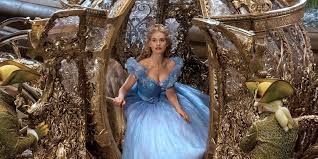
Image result for Cinderella 2015 film stills

    Additionally, the utilization of lighting and cinematographic techniques was downright mesmerizing. (Several scenes are dictated by the brilliant use of these two forgotten and incredibly vital ingredients of filmmaking.) The employment of high-intensity, overhead lighting in the expository scenes brilliantly illuminates the aura of Cinderella's mother, who ultimately comes to symbolize the very fiber of her being; this is in direct contrast to the Lady Tremaine, whose scenes are enshrouded in shadows and characterized by a harsh diffusion of radiance. In fact, there is even the presence of an extremely underrated lighting effect as once the cruel Lady Tremaine arrives at the castle for the ball (in hopes that one of her crude daughters can coax the prince into marriage), we see fireworks literally light up her eyes.

    In true fairy tale fashion, we are brought into the fold via a subtle zooming of the cameraas if we were a general observer who had just become entranced by the events at hand. As a matter of fact, it is this objective, or spectator if you will, point of view that dominates the picture, and although it creates a sense of emotional distance between the characters and the audience, it is entirely warranted here. The cinematic composition of the film is exquisitely designed, as every object of dramatic significance is focused upon precisely in every scene and while depth is conveyed adequately through what normally appears to be a flat surface. (The latter of which is executed in a plethora of manners. None more startling, however, than the image of the Lady Tremaine, produced by way of foreground framing, as she is presented to us through the pane of a window and as she eavesdrops on a conversation between Ella and her father.)

    Beyond the visual department, however, are the performances of Lily James and Helena Bonham Carter, both of which never flounder in their vitality. James, in her first leading role in a genuine box-office production, is simply picture perfect in her interpretation of Cinderella, and her beautiful yet innocent appearance is so conceivable that we are ultimately distracted from her talents as an actress. Not only does her sincerity permeate the foundation of the film, but it is her reaction shots that emphasize the delicacy of her character. In essence, Cinderella is the tormented heroine, which is quite a difficult element to convey, especially when one considers the natural cheerfulness of her personality. Although emotional restraint is enacted without hesitancy, James shines in several scenes where this subtle pain must be felt in order to satisfy the needs of the performance.

    Carter, in a role that brims with stereotypical character irony (considering the despicable nature of her previous undertakings), portrays the Fairy Godmother in such a way that it enlivens the atmosphere of the picture invariably. She surely brings magic to a scene that desperately requires it, and, most importantly, she seemed to have a great deal of fun while doing so.


Image result for Cinderella 2015 film Cate Blanchett

    With all that being said, the gem of the film is unquestionably Cate Blanchett in her portrayal of the vile stepmother Lady Tremaine. Blanchett is unmatched in poise and demeanor as she controls scene after scene with her frigid execution of dialogue and mannerisms that conjure up thoughts of a snake in the grass. She is obviously more wicked than the original depiction of the same character, and it is this quality that is illustrated so well that it almost seems as if terror oozes directly from her physical appearance, among other places.

    There are a handful of differences between this rendition and the original: Most notably, being the presence of the songs and the importance of the surrounding animals. There is no denying that the songs were an integral portion of the original production, and although this film was never intended to be a musical, one is left to wonder how "Bippity Boppity Boo" could have complimented the eccentric performance of Carter. As far as Gus and company are concerned, their importance has diminished somewhat although they still provide an emotional outlet for Cinderella and the opportunity for unwarranted humor. The integration of the computer-generated mice is sufficient enough and never intrudes where it shouldn't. In fact, they still help Cinderella construct her evening gown for the ball, although the refashioned scene is surely not as grand as the original.

    "Cinderella" also finds success in the parallel storyline of the prince. The persona of our lovable prince charming is discerned through several well-crafted scenes in which we learn of his own conflict, which primarily stems from the temporal factors aligned with royalty and the accompanying pressure to marry within one's social hierarchy. This absolutely gives depth to a character that is universally renown for his flat personality, and it impels the story in the right direction time after time.

    Looking back, it is evident that the original "Cinderella" released at a pivotal time for the Disney corporation, as a heavy debt instilled a sense of uneasiness and melancholy throughout the company. The financial success of the film helped to eliminate the doom and gloom mentality, and it has since become cherished as a masterpiece of animation and innovation. Although this latest rendition does rely on the aforementioned theme of moral implication (which, in this particular instance, lies in the realm of courage and kindness), one thing has not changed: "Cinderella" is a film that teaches young children to never surrender who they truly are. She is a character of average stature who becomes a princess for seemingly no other reason than because she is a woman and because she never pretends to be what she is not. Every young girl dreams of becoming a princess; the story of Cinderella simply makes it happen.

Thursday, March 19, 2015

CHAPPiE ★★

Image result for Chappie film stills


    "CHAPPiE" is a picture that suffers mightily from a fear of making decisions or if you prefer the correct medical term, Decidophobia. Here is a story that has the potential to command a great sense of emotional depth from its characters, yet the hesitancy to capitalize on such notions places it in a constraint that it, unfortunately, can never quite escape.

    There was a point in the film where I thought CHAPPiE could possibly symbolize the youth of America, and the surrounding instruction of violence and degradation would have served as an accurate contemporary view of society's undoing; consequently, crafting a theme of social commentary, and if there was room for ingenuity, maybe a focus of moral implication. Another direction could have relied on CHAPPiE's innocence and the inevitable eradication of such sentiments. However, these aims never come to fruition, and ultimately become superseded by mindless action and subplots that would inspire moments of utter bewilderment.

    In a realm similar to that of "Robocop," we are introduced to a world filled with brutality, barbarism, and destruction, only to find out that it is in actuality the city of Johannesburg, South Africa, in the year of 2016. We learn that the local police force have been replaced by a mechanized artificial intelligence (by way of a choppy documentary style exposition) and that our main protagonist, and designer of the above-mentioned workforce, Deon Wilson, has an intention of bestowing one of the models with a human conscious. Unlike "Robocop," however, where the motive involved instilling cold blooded objectivity into an officer of the law, the film attempts to provide sensitivity to a universally recognized body of bolts.

Image result for Chappie film stills


    Enter unwarranted storyline number one: Somewhere in the outlying provinces, among the threshold of poverty and in a place eerily comparable to the apocalyptic environment of "Mad Max," resides a group of outlaws who apparently have a large debt to a leader of another gang. This impels the three individuals into a scheme of kidnapping, where they stalk Wilson, force him to create CHAPPiE, only to threaten him with death afterward. The head thug, Ninja, begins to toughen up the demeanor of the adolescent robot (it becomes known that CHAPPiE's conscious will begin as a child, much like our own) by coaxing him into committing crimes of grand theft auto and by enshrouding him in a lifestyle filled with gold chains and bullet rounds. The objective? CHAPPiE will be utilized to achieve the most strategic of heists: robbing an armored van.

    Enter unwarranted storyline number two: In the midst of CHAPPiE's indulgence in this rather unsophisticated way of living, he becomes enamored with the presence of the resident female of the pack, named Yolandi, and after some time, he becomes a victim of Stockholm syndrome. This paves the way for several scenes to be infused with tenderness, and although they are touching at times, they are eventually drowned out by the existence of the first subplot and substandard acting.

    Enter unwarranted storyline number three: Vincent Moore, a fellow engineer to Wilson at the lovely corporation of TetraVaal, (the organization that produces these robot crime fighters) is a man consumed by jealousy, as his latest invention, the MOOSE, (a larger, more intimidating mechanical creation) has been passed over for production in favor of the Scout model. (CHAPPiE's make) This leads to the foreseeable acts of sabotage and revenge, as Moore is intent on ruining Wilson's success and regaining popularity among his co-workers.

    Dev Patel, a young actor who got his break in the 2008 film entitled "Slumdog Millionaire," is somewhat out of his element in this role, much like his co-star in Hugh Jackman, who has not looked more confused in a performance since "Movie 43," a part in which male testicles were attached to his persona's chin. Jackman is evidently the foil to Patel, although the lack of depth in the characterization of Wilson completely thwarts these efforts. (How can one emphasis, through contrast, the qualities of a character when they simply are not present?)

    The issue with "CHAPPiE" is its inability to dream; this was a perfect opportunity to divulge into a wonderful character study, however, we are left with nothing but a plot driven ambition that thrives in its contrived circumstances and less than innovative approach to filmmaking. There are two scenes, in particular, that serve as proof of this missed possibility.

    Firstly, there is a moment in which Wilson and Yolandi teach CHAPPiE how to paint that recalls the classic television program entitled "The Joy of Painting," starring one of my favorite human beings in Bob Ross. Wilson even paraphrases one of Ross' most famous lines, in which we are told that the canvas is our world and that it can be anything that we want it to be. Yet, this sentimentality is never utilized to its maximum potential and ultimately becomes lost under the plethora of gratuitous plotlines that hamper the picture's success.

    Secondly, there is an uplifting scene in which CHAPPiE partakes in a viewing of a "He-Man" animated program; subsequently, mimicking the main character's well-known catchphrase and movements. This brings to mind a similar instance in "The Iron Giant," where the central figure adopts the personality of Superman, in a venture to become his cherished idol. Although this idea has been used before, the teasing of such moments that are never delivered seems downright imprudent.

    Beyond these miscalculations, however, is a scene that accurately summarizes the complication at hand. After our main protagonist initially proposes his concept for a consciously aware robot, the TetraVaal CEO (played by Sigourney Weaver, who is also set to work with Blomkamp in the future "Aliens" production.) reiterates the undesired need for a machine that can write poetry, among other things. The fear to impart imagination, and even a hint of ambiguity, onto an audience, is an apprehension that must be forgotten in order to truly create a work of art. As far as heartwarming robot stories are concerned, "WALL-E" is still head of its class.

Saturday, March 14, 2015

Focus ★★

Image result for Focus movie poster


    For a film with the title of "Focus," there seems to be very little of it. I mean, here is a picture with an identity crisis. Is it a drama? Well, if it is, then it is an exceedingly poor one. Is it a dark comedy? I for one am not entirely sure, yet if it desires to partake in this designation, then it is certainly a bland rendition of the genre, as its crude humor and vulgar dialogue evoke anything but laughter.

    I guess the most fundamental question to ask would be: Is it worth watching? My answer would be a resounding no although I am sure that its vacuous entertainment value will not be lost on everyone.

    Nicky (Will Smith) is a seasoned con man who spends his time traveling the country with a small group of employees, roaming from city to city in an effort to pull off smaller cons, as we are told that the "big score" is only an illusion and quite unrealistic. Enter Jess (Margot Robbie), an amateur grifter who attempts to swindle Nicky by way of her sexual appeal. (Which is rather plentiful.) She ultimately fails, nevertheless, catching the eye of Nicky and subsequently persuading him to take her under his wing; after a period of "Con 101," the two hopelessly fall in love.

    The remainder of the picture relies heavily on the internal conflict surrounding Smith's character, as he was always taught not to indulge in the softer emotions. This leads to an inevitable break-up between the two lovers, which primarily sets the stage for further complication, as Nicky finds himself face-to-face with Jess three years later, after he takes his latest job in Buenos Aires.

    There are several sequences of heists which hinge on the prediction of human behavior and most of which are so absurd in their design that they would make the "Ocean" series of films quite proud. (The most notable consisting of numerous bets with a well-to-do businessman--at a championship football game--who apparently travels with millions of dollars in cash just for these occasions.) The highly sought after style of this genre does permeate the film, yet it is bogged down by a script that lacks any hint of imagination.

Image result for Focus film stills

    Will Smith, a prime example of a former personality actor who has completely eradicated his typecasting persona, is quite sincere in a lead role that suits his current interpretive method of acting, although much of the success can be attributed to the wonderful chemistry shared with his co-star. Margot Robbie is as beautiful as she is talented, and the young actress dominates the screen with her robust and quirky personality; an indicator that she can surely step into a more complex role than that of a trophy wife--a performance in which she indulged for "The Wolf of Wall Street." The humorous nature of their relationship strikes gold and becomes nothing short of definitive proof that an inter-racial couple can succeed in highlighting a box office production.

    Two noteworthy issues arise, however, when one takes it upon themselves to observe, instead of merely just seeing the picture. Firstly, it would seem as if the unification of the plot was thrown out the window in an attempt to actually come up with a story. Case in point: There is little chance that Smith's character would dismiss the young beauty in order to keep his dignity. (Most men would die for a shot with a gorgeous woman and millions of dollars in cash.) Are we to believe that our anti-hero is a man of morals? Hardly the circumstance I would say, considering he is a con man who steals, cheats, and relinquishes a portion of his good will each day for a chance to acquire wealth, among other things.  

    Secondly, and most important, is the nature of the characters themselves. Sure, they enliven the mood with their attitude toward one another, yet there is not much for the audience to latch onto. I cannot remember a film that provided such an emotional distance where the fate of the characters would seem negligible, and quite frankly, uninteresting.

    As a belligerent Smith parades around a nightclub, in what becomes the main deception of the film, one cannot help but to be reminded of a similar scenario in what was the actor's breakthrough television sitcom entitled "The Fresh Prince of Bel-Air." The young and charismatic personality of that Will Smith is something that this picture direly warranted, although I am sure Smith would never pine to relive such moments of his career. By the film's end, there was nothing left for me except a thought of a simpler past time, and one in which Smith's body of work can attest to; maturity is unavoidable.

Wednesday, March 11, 2015

Jackie Chan's First Strike ★★1/2

 Image result for Jackie Chan's first strike stills


    If you have never seen a Jackie Chan action film, then you are surely missing out on two wonderful aspects of filmmaking: graceful choreography and nonchalant humor. Although these characteristics are a staple in Chan's best pictures, it is the shortage of these irreplaceable things that makes "Jackie Chan's First Strike" pale in comparison to films such as "Rumble in the Bronx," the latter of which becoming relentless in its efforts to employ such techniques.

    The plot, as negligible as it may seem, centers on Jackie and his attempt to bust a former CIA agent's scheme to sell nuclear weapons to a Russian mafia. This takes our skilled martial artist to Ukraine, Russia, and ultimately Australia, as our protagonist must track down the arms dealer and restore justice to the world in the only way that we know he can: with a large dosage of wholesome fist fighting. There are twists, turns, and smokescreens, along with a plethora of dialogue that is not easily followed, considering the poor quality of dubbing. (Another mainspring of Chan's films.)

    Action scenes are in abundance, although it is the nature of these instances that fail to provide the fast paced and frenetic entertainment that we are normally accustomed. In fact, most of the action takes a back seat to the storyline, which is as unfavorable as it is unneeded. I guess the focus on such trivial matters is nothing more than a political decision, as it has been quite a struggle for Chan to get a national release here in the United States. Yet, that is the beauty of these films. (Who needs a story when the martial arts choreography deserves a stage of its own?)

    Sure, there is an opening sequence composed of racing snowmobiles and snow skiing gunman that provides an adequate fulfilling of adrenaline-laced insanity. Additionally, there is a fighting scene which sees Chan utilize a ladder, among other things, to fight off a group of adversaries who believe that our beloved hero has committed a homicide. Other scenes (consisting of a confrontation at a hotel and the local aquarium) tend to forgo the formerly mentioned action that makes these pictures so delightful, as the plot's resolving regrettably becomes the center of attention. As strange as it is to desire vacuous entertainment, this is a genre of filmmaking where it is direly warranted, and "Jackie Chan's First Strike" unfortunately cannot provide enough.

    I must wholeheartedly agree with one of my contemporaries, that being Roger Ebert, as he puts forth the notion that a Jackie Chan film is one of an acquired taste. This is undeniably true and a fact that can only be realized after numerous showings of the like. There is just something about a man who risks his well-being in order to do his own stunts. (Most of which are in reality quite dangerous.) It takes a lot of pride and gusto to accomplish such feats, and Chan is really only doing what young adolescent boys attempt to do in every hour of play--that is--to become your very own action hero.


Sunday, March 8, 2015

Marie Antoinette ★★★1/2

Image result for Marie Antoinette movie stills


    "Marie Antoinette" is an exquisite film if for no other reason than its elegant visual style, which captures the sublimity of the Romantic era of France in all of its conniving splendor. Sofia Coppola's chronicling of the egocentric queen is not only proof of her innate talent as a director (it is quite clear that the Coppola bloodline is infused with boundless ingenuity), but it displays her maturity in executing the art itself, which can be ascertained scene after scene. 

    Of course, it would be relatively impossible to indulge in every instance where the picture's beauty becomes prominent simply because it ruthlessly permeates each frame in such a manner that brings the phrase "feast for the senses" into relevance. From delectable treats to wardrobe and make-up, it is evident that the production design team worked flawlessly to resurrect this setting in its pristine glory, down to the minute detail. 

    However, the decision to utilize rough grain film stock was obviously the most critical determination of the visual blueprint, as the grainy texture (which can be comparable to an eye-sore if not performed with care) accentuates the story masterfully. One of the most difficult aspects of creating a period piece is the ability to recreate an atmosphere so that the audience's imagination does not have to; I was so enthralled at times that I thought to leave this place would truly be a sin.  

    Yet, as captivating as the picture may be visually, it is the direction that propels the story to success. Coppola's presence behind the camera can be felt throughout, as every cinematic point of view is used to its maximum potential. We journey with young Marie in a very intimate fashion early on as the subjective viewpoint is utilized to show events exactly as they were seen by the young queen; the audience becomes nothing short of a direct participant in the action while Marie takes her first steps into this foreign realm of wealth and power. This choice of presentation is undoubtedly brilliant and only alludes to Coppola's growth as a filmmaker. (There are also numerous shots of Malick-esque proportions, as slow and methodical scenes of nature are presented to us in their truest form--untouched.)

    To say that the film provides an abundance of symbolism would be more of an insult than anything, as it is not only provided but littered in every crevice of live screen and employed in every imaginable technique to date. Repetition is used to give depth to several concepts, including letters from Marie's homeland of Austria and gossip that can be overheard in every segment of dialogue. (The former symbolizing her conflicts and the latter symbolizing the pressures and nuisances accompanied with royalty.) 


Image result for marie antoinette film stills

    Visual metaphors are crafted in the most subtle of ways and define numerous ideas such as the royal couple's inability to consummate and romanticized daydreams of Marie herself, as she inevitably partakes in infidelity. Single shot motifs are used to convey several notions, most notably that of vulnerability, which is best encapsulated by a scene in which Marie helplessly stands naked during her first-morning routine.     

    In spite of the bombardment of captivating styles and textures, however, it occurred to me that as well as the film divulges into the finer memories of Marie Antoinette's iconic lifestyle, it does not express the conflict adequately enough to bring this sphere of life into complete coherence. This is surely not to say that complications do not exist, as the pressure to adapt and to fulfill temporal roles would seem daunting enough, yet once they are provided, it becomes more of a distraction and hindrance than an added element to her character.

    Quite frankly, it places our resident actress, Kirsten Dunst, in an unflattering constraint, as scenes that direly warrant a depth of emotion become forced and unnatural; the latter being a reversal of the quality that Dunst undoubtedly expressed with pride earlier in the picture. Case in point: When Marie is told of news from home that would seem heartbreaking, Dunst is at a loss for conviction and her reaction shot fails to express the needed emotions convincingly.

    Nevertheless, the most startling facet of the film can only be the dramatic irony that is at play behind the scenes. If you are familiar with the history that accompanies this characterization, then you surely know what this is in reference to. The simple fact that we become empathetic towards a persona who certainly does not deserve it is a testament to the picture's aims. It humanizes a character in an attempt to evoke sympathy from its audience and it succeeds invariably.                 

Wednesday, March 4, 2015

Tracers ★

Image result for Tracers movie still


    My experience with this picture was certainly one of a humbling tone considering I never thought another action film starring Taylor Lautner would come to fruitionyet it hasand much like the 2011 floundering entitled "Abduction," it would seem that the same ploy is being utilized in order to gain that highly sought-after net revenue.

    Even if the chief objective succeeds (that being the generation of a few million dollars to accompany a low-budget production), there is another aspect that should be acknowledged here: It is obvious that Lautner has come to accept his typecasting future, as his face once again headlines a story that not only provides little depth to its structure, but it seems to be infused with boundless mediocrity. An actor who becomes caught in the snares of typecasting is a delicate creature who warrants much empathy.

   For those of you who are direly interested in the plot, here it is: Cam, a young bike messenger with a somewhat troubled past, resides in New York Cityit is the only place that he's ever known and his accurate knowledge of the streets enables him to succeed in this modest career. Not only does he have to scrounge rent money (even a garage space costs $550 per month in this economy), be he also has to make loan payments to the local Chinese mafia. At this juncture, it becomes evident that Cam is the victim, a role that Lautner knows all too well, and we are supposed to sympathize with him even if there is no beguile to justify it.

   In a seemingly fateful incident, our protagonist meets another troubled teenager by the name of Nikki, a young girl who is as beautiful as she is troublesome. Nikki is part of a group that roams the urban regions of New York practicing the art of "parkour," a freestyle exercise that consists of unhampered body movements such as running and jumping that are exercised over any obstacle. Yes, it is as silly as it sounds, and although it does take some athletic ability to control one's movement with precision and speed, the stunts provided for us have a hint of lifelessness to them.

   The rest of the film is dominated by these swift motions as the hand-held camera becomes the most vital tool for its construction. Beyond the fact that the action is choppy and unflattering in every sense of the word, it becomes slightly monotonous and quite uneventful. (In fact, I found my mind drifting off to general wanderings, which included the observation that the inner city was teeming with vacant warehouses and buildings clearly in an attempt to give our fleeing characters more running room). Throw in a corrupt DEA agent and a number of secretive missions, and the parkour athlete transitions into that of a "Tracer," which pays better but comes with increased risk.

   In light of all these statements, a burning question comes to mind: What has happened to the action genre? Is this truly what we have come to? It is correct to take the budget of the picture into account; however, it does not defend against the sheer lack of inspiration. With Liam Neeson as the sole anchor of these types of movies in today's film industry, and with the declining prominence of actors such as Jason Statham, there does seem to be a sense of leeway for a rising action star. I've stated before that it is not Lautner's inability to act that obstructs him from success but the roles in which he partakes. If the former "Twilight" heartthrob has any chance of overcoming this hindrance, he must shed this teenage persona. This product is nothing short of a growing pain for an actor who is not manly enough to play bigger roles; consequently, binding him to these types of performances that suffer from poor writing and a lack of innovation.

   As the lights of the theater regained their vitality, there were two thoughts that crossed my mind: Early in the film, there is a scene that plays on Shakespeare's "Romeo and Juliet," as Cam, a lowly bike messenger, attempts to converse with Nikki, a well-to-do parkour enthusiast. She is suspended in the air while he is begrudgingly attached to the ground. Although the names of Montague and Capulet are never uttered, it does allude to such notions (if only for a brief moment), and one can only imagine what could have been if they would have remained with this formulaat least, it would have been more entertaining.

   *On a side note, it has come to my attention that the mafia seems to be slacking in the manner in which they qualify loan recipients. I mean, why give fifteen thousand dollars to a young man who has little ability to return the investment? Is this just an excuse so that they may later injure the individual in question? It seems to me that the stereotypical mob needs a new image and apparently an accountant.